Switzerland's Sustainability Initiatives Inspiring Resource Management Mechanics in Free-to-Play Mobile Action and Puzzle Titles Developed Within the Local Community
Geschrieben von Mia Richter · 12.10.2026
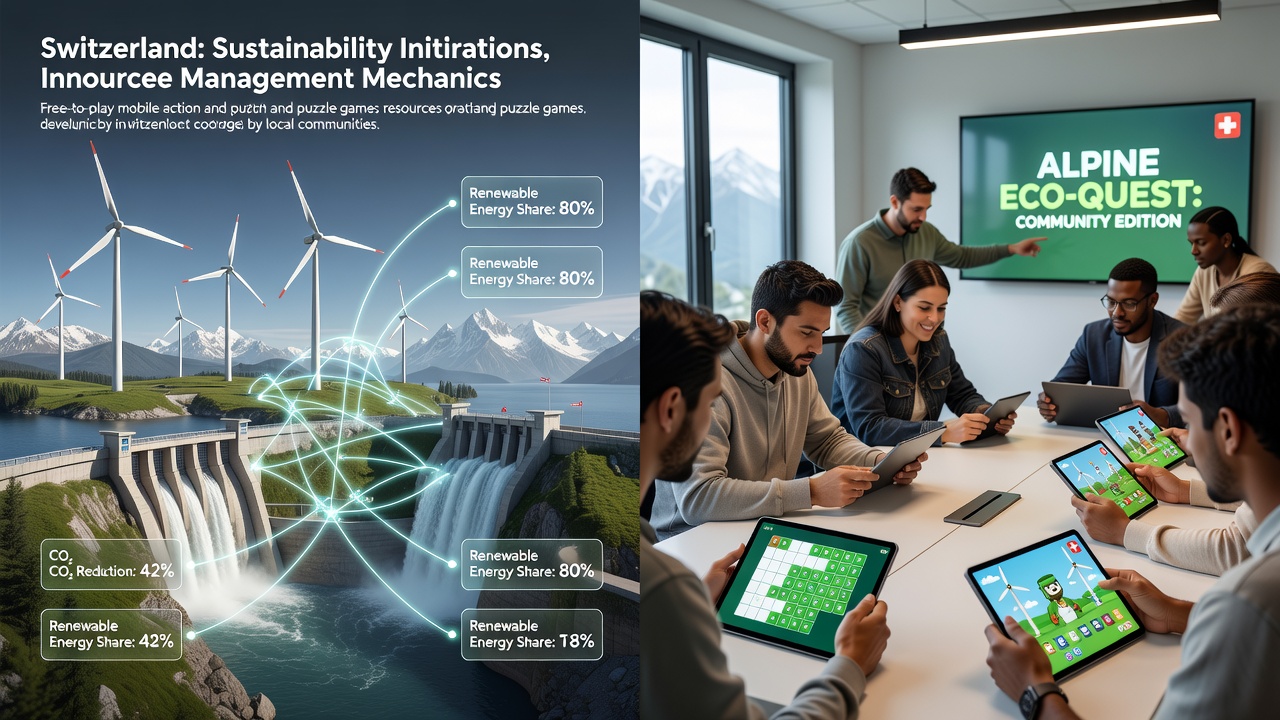
Switzerland's Sustainability Initiatives Inspiring Resource Management Mechanics in Free-to-Play Mobile Action and Puzzle Titles Developed Within the Local Community
Switzerland maintains a long record of environmental policies that prioritize renewable energy sources, efficient public systems, and waste reduction programs, and developers in the local gaming sector have drawn direct parallels between these national efforts and mechanics centered on limited resources in free-to-play mobile action and puzzle titles. Federal targets for carbon neutrality by 2050, combined with cantonal incentives for green technology adoption, supply a steady stream of data that game studios reference when designing energy bars, material collection limits, and regeneration cycles.
Policy Foundations and Their Translation Into Game Systems
The Swiss Federal Office for the Environment tracks annual reductions in per-capita energy consumption and publishes figures that show consistent progress in hydroelectric and solar output, and several studios located in Zurich and Geneva have incorporated similar metrics into core loops where players must balance short-term gains against long-term sustainability. Research from the Swiss Federal Institute of Technology indicates that resource-scarcity models perform better when they mirror real-world constraints such as seasonal water availability or grid load fluctuations, leading to puzzle stages that require players to reroute power flows or conserve items across multiple rounds.
Action titles developed by smaller teams in Basel integrate vehicle-charging stations that recharge only during simulated daylight hours, reflecting national solar expansion statistics released in recent years. These mechanics appear in games where characters traverse alpine routes and must decide whether to expend stored energy for speed boosts or save it for later defensive maneuvers, creating decision trees that echo the trade-offs documented in official mobility reports.
Community-Driven Development Practices
Local meetups organized by the Swiss Game Developers Association bring together programmers, artists, and data analysts who share case studies on adapting public transit timetables into cooldown timers or converting recycling quotas into bonus multipliers. One studio in Lausanne released a puzzle title in which matching colored blocks represents sorting municipal waste streams, with success rates tied to accuracy thresholds published by cantonal environmental agencies. Players advance only when they maintain efficiency levels above documented national averages, turning routine sessions into exercises that parallel actual policy benchmarks.
October 2026 marks the scheduled release window for an updated toolkit from the same association that will include open-source modules for modeling biodiversity offsets, and early adopters among mobile studios plan to embed these tools into action sequences where character upgrades depend on preserving virtual ecosystems rather than simple point accumulation.

Cross-Regional Examples and Data Integration
Developers in Ticino have produced action games that feature water-flow puzzles calibrated against measurements from the Swiss Hydrological Survey, requiring players to time dam releases so downstream objectives remain achievable without depleting reserves. Data from the European Environment Agency shows comparable patterns in neighboring regions, yet Swiss titles distinguish themselves by layering linguistic-region variations, such as German-speaking cantons favoring precision timers while French-speaking areas emphasize collaborative resource pools in multiplayer modes.
Academic papers from the University of St. Gallen examine how these mechanics affect retention rates, noting that titles incorporating verifiable sustainability metrics retain players longer when updates align with real policy milestones. Figures released by the International Energy Agency confirm that Switzerland's renewable share exceeded 60 percent in the most recent reporting period, and several games now display progress bars calibrated to those exact percentages during seasonal events.
Future Outlook and Ongoing Adjustments
Studios continue to refine algorithms so that resource depletion curves match projections from the Federal Office of Energy, and community forums host regular discussions on balancing monetization with authentic scarcity models. New titles scheduled for late 2026 will introduce weather-variable events drawn from MeteoSwiss forecasts, forcing players to adapt strategies when simulated storms reduce solar input or increase hydroelectric potential.
Conclusion
The integration of Switzerland's documented sustainability targets into free-to-play mobile action and puzzle mechanics demonstrates a measurable exchange between public policy data and private development practices, with resource systems that reflect actual environmental statistics rather than abstract numbers. Continued collaboration between agencies adn studios ensures these features evolve alongside national progress reports, maintaining alignment between game design choices and measurable outcomes in energy, mobility, and waste sectors.